



Climate, forests, water resources: Basf's climate commitment assessed by CDP
The non-profit organisation CDP (Carbon Disclosure Project) has awarded Basf an "A" rating in climate protection and forest conservation and an "A-" rating in sustainable water resource management, confirming the German multinational's leading position in all three categories. "This renewed recognition from CDP confirms our constant commitment and the effectiveness of our sustainability strategy. BASF will continue to develop innovative solutions for its customers and pursue an ambitious programme to contribute to a sustainable future," stated Christoph Jaekel, Head of Corporate Sustainability at BASF.
Basf has participated in CDP's climate protection data reporting programme since 2004, which, amongst other things, assesses transparency in emissions reporting, management of climate change-related risks and opportunities, climate protection strategy and measures to reduce CO2 emissions. The company has set itself the goal of reducing its Scope 1 and Scope 2 CO2 emissions by 25% by 2030 (compared to 2018), whilst continuing to increase production. The target is based on emission reduction pathways outlined by the International Energy Agency (IEA) in its "Net Zero by 2050" study, in line with the 1.5°C global warming limit. It also aims to reduce Scope 3.1 CO2 emissions by 15% (compared to 2022) across its entire product portfolio. It plans to achieve net-zero Scope 1, 2 and 3 emissions by 2050. The German multinational has achieved an "A" rating in forest protection for the first time. This assessment is based on a detailed analysis of the palm oil supply chain and activities that have an impact on ecosystems and habitats. Palm kernel oil and its primary derivatives are amongst the company's most important renewable raw materials. The highest score was achieved thanks to, amongst other things, high transparency on raw materials and supply chains relevant to deforestation, a high level of public engagement, and activities and initiatives such as smallholder projects in the palm oil supply chain.
Basf also received an "A-" rating for water security. A CDP guideline establishes that companies that manufacture products containing hazardous substances cannot receive an "A" in this category. The assessment takes into account the transparency with which companies report their water management activities and how they reduce risks such as water scarcity. CDP also evaluates the extent to which the product development of assessed companies can contribute to sustainable water resource management by their customers. BASF is implementing sustainable water management by 2030 at all Verbund sites and at production sites in water-stressed areas. In 2024, achievement of the target was 65%.
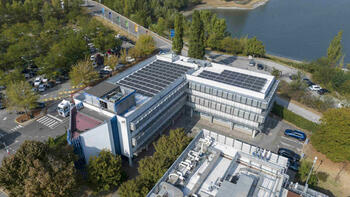
Regarding Italy, the company's commitment to sustainability continues through the expansion of renewable energy production. At the headquarters in Cesano Maderno (Milan), a ground-mounted 346 kW photovoltaic system is operational, with an estimated annual productivity of over 504,000 kWh – equivalent to approximately 15% of the site's requirements – potentially avoiding the emission of 158 tonnes of CO2 each year. The Pontecchio Marconi (Bologna) plant (in the photo) also contributes to the decarbonisation pathway thanks to the photovoltaic system installed on non-production buildings and in some areas of the car park (320 kW), capable of generating approximately 438,500 kWh per year and reducing emissions by a further 138 tonnes of CO2. Since 2021, Basf has only purchased certified renewable electricity through green certificates, strengthening its contribution to the Italian energy transition. Supporting the decarbonisation pathway, the group integrates renewable energy with high-efficiency cogeneration plants, capable of optimising resource use and contributing to a further reduction in CO2 emissions.

Most read news