




CMG Granulators' First Carbon Footprint
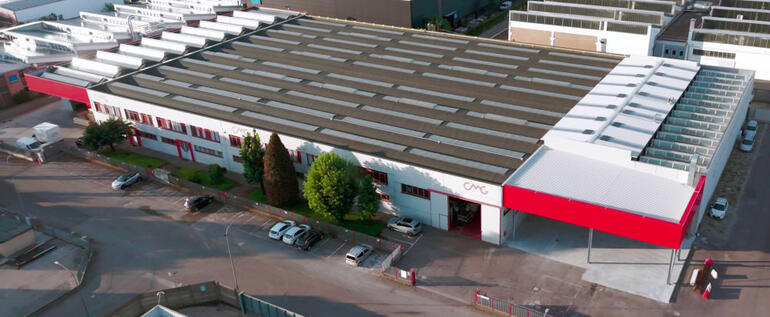
First assessment of its organisational carbon footprint (or GHG inventory) for CMG Granulators' facility in Budrio (pictured), with the objective of understanding and evaluating its performance in this area in 2024 and comparing it with the baseline year 2019.
The measurement and reporting of greenhouse gas emissions from a product, service or organisation throughout its entire life cycle is now a crucial aspect for implementing concrete policies and actions for their reduction in order to stem the damage arising from climate change. The primary objective of determining an organisational carbon footprint (CFO) is to quantify the potential impact of the organisation's activities on global warming. Specifically, CFO is the measure of direct or indirect greenhouse gas (GHG) emissions produced by the organisation's activities. CFO results are expressed in CO₂ equivalent (CO₂eq), an environmental indicator that expresses and encompasses all greenhouse gas emissions emitted directly or indirectly by the organisation.
The emissions calculated in the study are of Scope 1 and Scope 2 types. Scope 1, namely direct emissions arising from activities owned or controlled by the organisation that release emissions into the atmosphere, may include direct emissions from stationary combustion: fossil fuels or biomass burnt in fixed equipment (for example boilers); direct from mobile combustion: fuel used in transport (for example company fleet vehicles); process emissions: arising from industrial processes; fugitive emissions: unintentional release of greenhouse gases (for example refrigeration systems); emissions and removals from land use and forestry. Scope 2, instead, concerns indirect emissions released into the atmosphere associated with the consumption of purchased electricity, heat, steam and cooling, which may be estimated following two approaches: market-based reflects greenhouse gas emissions based on any specific contracts the organisation has with the electricity supplier, allowing consideration of the characteristics of the energy actually purchased and, in the absence of specific contracts, will reflect the greenhouse gas emissions of untracked grid electricity (residual mix); location-based uses the average emission factor for energy produced in the country where the plant operates, regardless of supplier selection.
CMG Granulators' CFO revealed that Scope 1 and 2 emissions measured for 2024 totalled 206 t CO₂eq (market-based approach), of which 78% was due to Scope 1 emissions linked to direct emissions from fixed combustion. Scope 2 emissions contribute 22% of the total carbon footprint and the main contribution comes from indirect emissions linked to the production of the electrical mix consumed by the company. Comparing 2024 data with those from the baseline year 2019, a significant overall reduction in Scope 1 and 2 emissions was detected, equal to 14%. This result is mainly attributable to the marked decrease in indirect emissions from purchased energy (Scope 2), which fell by 47% compared to 2019. Analysis of emission intensity relative to turnover, expressed in tonnes of CO₂eq per thousand euros (tCO₂eq/k€), shows a reduction in carbon intensity from 0.028 tCO₂eq/k€ in 2019 to 0.017 tCO₂eq/k€ in 2024, namely a reduction in emission intensity of 40%.

Most read news