



Engel's injection moulding solutions for humanoid robots
Humanoid robots are rapidly moving from research laboratories into industrial applications. The challenge, however, does not concern software and artificial intelligence alone: achieving series production requires hardware solutions capable of delivering lightweight, precise and durable components on a large scale. The technologies used in prototype development, such as CNC machining and 3D printing, are not easily scalable to the volumes and costs required by future industrial production. This is where injection moulding comes into play.
A transition already under way
Unlike mechanical machining processes, injection moulding makes it possible to produce complex components with sophisticated geometries, tight tolerances and a high level of functional integration in cycles lasting seconds rather than days. The result is a highly repeatable process that, as volumes increase, drastically reduces the unit cost. The transition from prototype to series production is no longer a future prospect: it is a reality that is already shaping design and procurement decisions across the entire sector. Decisions relating to technology partners, materials and the injection moulding process are made as early as the initial design phase and determine a product's competitiveness on an industrial scale. This is where the experience Engel has gained across a wide range of application sectors translates into a concrete advantage.
The robot's movement: actuators and mechanical precision
By converting energy into mechanical motion, actuators represent the muscles of a humanoid robot and, at the same time, one of the greatest design and economic challenges of the entire system. Each joint requires a high-precision housing capable of withstanding thermal stresses, maintaining extremely tight dimensional tolerances and integrating bearings, sensors and motor components without compromising lightness and compactness.
One of the most promising developments concerns the overmoulding of stators and rotors. Rather than insulating laminated stacks with paper and carrying out subsequent assembly operations, the metal core is directly overmoulded with high-performance engineering polymers, such as LCP, PPS or PA46. This integrates the functions of electrical insulation, winding guidance, pole geometry and connection interfaces into a single component. The result is a more compact, lightweight and efficient motor, characterised by better heat dissipation, higher winding density and a significantly simplified production process. It is precisely this functional integration that makes large-scale motor production economically viable.
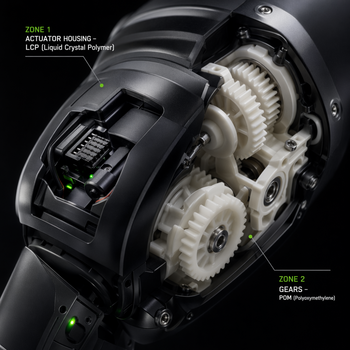
In this context, the role of advanced engineering polymers is decisive. PPS and PA46, both of which can be reinforced with glass fibre up to 40-50%, guarantee continuous operating temperatures above 150°C. LCPs, meanwhile, make it possible to achieve extremely thin-walled geometries with high dimensional stability, even close to sensitive electronic components and windings.
The hidden heart of movement: precision gears
Precision gears represent a second, and often underestimated, opportunity for injection moulding. Made from POM, they combine low friction, quiet operation and high wear resistance, making them a viable alternative to metal gears in numerous robotic joints. Achieving these performance levels, however, requires extremely accurate melt control and a very high degree of repeatability. For this reason, Engel has developed a plasticising unit optimised for processing POM, capable of guaranteeing consistent tooth geometry and dimensional precision, cycle after cycle.
Thanks to the high injection precision, thermal stability and process repeatability ensured by its technologies, Engel offers the ideal production platform for manufacturing actuator housings, overmoulded stators and precision gears. The possibility of integrating metal inserts, bearing seats or electrical contacts directly into the moulding process further expands the potential for functional integration and cost optimisation.
Lightness and aesthetics: the humanoid robot's identity
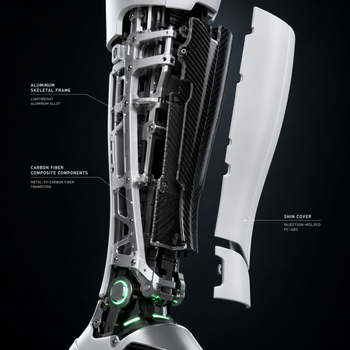
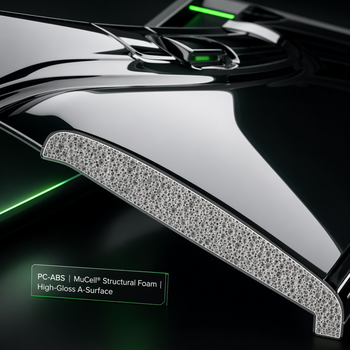
The outer shell is the element that defines a humanoid robot's identity. Covers, shoulder cladding and body shells must combine lightness, high surface quality and design freedom, while maintaining the economic viability required by series production. PC-ABS (a blend of polycarbonate and ABS) is the ideal choice for these applications, thanks to its combination of mechanical strength, aesthetic quality and design flexibility required for large components.
To lighten these elements without compromising performance, Engel offers two complementary microcellular foaming technologies: the physical MuCell process and chemical foaming using blowing agents. Both reduce weight and material consumption, improve dimensional stability and limit surface defects such as sink marks, while preserving the rigidity required by large cladding panels. The choice of the most suitable solution depends on the part geometry, production volumes and aesthetic objectives. Where surface quality plays a decisive role, Engel offers a wide portfolio of finishing processes: from heat & cool technologies, which achieve glossy surfaces free of visible imperfections, to foilmelt technology for integrating decorative and/or functional films directly into the component, through to In-Mould Labelling (IML), which allows permanent, highly scratch-resistant graphics to be applied. The most effective combination is identified according to the component's design, the required quality level and production volumes.
The robot's sight: optical and functional integration
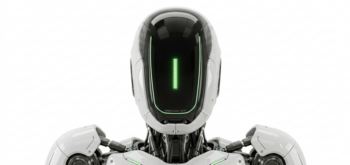
Behind the face of every humanoid robot lies one of its most sophisticated technologies: LiDAR units, stereo cameras and other optical sensors that enable it to interpret its surroundings. The front mask that protects and integrates these systems must therefore meet seemingly conflicting requirements: guaranteeing optical transparency and signal transmission in the areas dedicated to sensors, while offering impact resistance, dimensional stability and high aesthetic quality in the remaining areas.
This combination of requirements makes front masks an ideal application for two-component (2K) injection moulding. Among the most suitable materials are PC (polycarbonate), which provides robustness and aesthetic quality to the load-bearing structure, and PMMA (acrylic), which guarantees the optical transparency required for camera and LiDAR windows. The two materials are integrated directly within the mould, in a single production cycle, eliminating subsequent assembly or bonding operations.
For this application, Engel's two-platen duo series injection moulding machines equipped with a rotary table represent a particularly effective solution. The substrate is moulded in the first station, after which the mould rotates and the second material is injected within the same clamping unit. This process guarantees high precision and repeatability in the production of two-component parts with complex optical requirements, combining quality, efficiency and productivity on an industrial scale.
The robot's nervous system: connections and miniaturisation
In every humanoid robot, hundreds of miniaturised connectors, sensor supports and electronic board housings ensure the connection and protection of internal systems. Liquid crystal polymers (LCPs) are today one of the reference materials for high-frequency connectors and miniaturised electronic components: they make it possible to produce extremely thin-walled parts (just a few tenths of a millimetre), show high resistance to reflow soldering and ensure excellent signal integrity at high frequencies. These characteristics make them ideal for achieving the levels of miniaturisation required by next-generation robotic architectures.
Thanks to decades of experience in processing LCPs for connectors and electronic components, Engel has the technological expertise needed to tackle these high-precision applications. Fully electric injection moulding machines, combined with extremely accurate control of injection speed, make it possible to produce ultra-thin-walled microelectronic components with high quality and repeatability. The use of multi-cavity moulds also makes high-volume production economically viable, even for extremely small components.
Rounding out the range of materials dedicated to the robot's electronics are PPS, PEI and PA6T/PA9T, used for sensor housings, power distribution systems and battery covers. These are applications that require a combination of flame retardancy, dimensional stability and electrical insulation: requirements that make advanced engineering polymers a viable alternative to metals, while also delivering a significant reduction in weight.
The robot's sense of touch: materials and technologies for a new dexterity
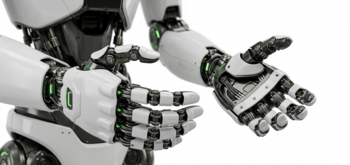
The ability to manipulate objects with human-like dexterity is one of the most complex challenges in humanoid robotics. Finger segments, tactile pads, flexible joints and sensor-equipped fingertips require materials capable of combining structural rigidity, controlled elasticity and functional integration capability. This combination is made possible by multi-component injection moulding within a single production process. Engel's two-component (2K) and multi-material moulding technologies make it possible to combine, within the same cycle, rigid structural substrates – typically PA12, PA6 or POM (particularly suitable for low-friction sliding elements and precision gears) – with the overmoulding of soft polymers such as TPU or TPE.
This solution eliminates subsequent assembly operations, improves adhesion between materials and enables geometries with complex functionality that would be difficult to achieve with separate components. For applications requiring a skin-like tactile feel and biocompatible surfaces, Engel's liquid silicone rubber (LSR) technology makes it possible to produce high-precision, flash-free silicone components. The combination of thermal stability, flexibility and ease of cleaning makes the material particularly suitable for producing fingertips and gripping surfaces. Furthermore, thanks to the overmoulding of sensors and functional inserts, it is possible to integrate directly into the moulded component the tactile technologies needed for contact detection, bringing the robot's sensitivity ever closer to that of a human.
From precision to scalability
The challenge of humanoid robotics is not only to design advanced components, but to make them reliable, repeatable and economically viable on a large scale. This is where expertise in materials, machinery, processes and automation becomes decisive. Thanks to its experience in developing advanced injection moulding solutions, Engel is helping to turn humanoid robotics innovations into real industrial applications.


Most read news