



Thermoforming machine for aerospace components
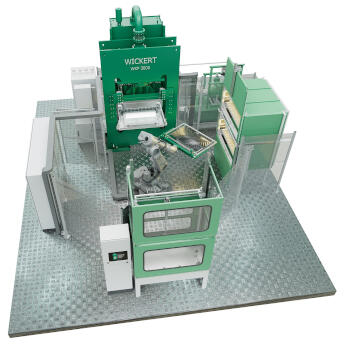
Wickert Maschinenbau has developed a new, particularly efficient and fast thermoforming machine for the production of aircraft structural components from composite materials. The semi-automated concept enables productivity increases of up to 80%. The machine, which will be presented at the upcoming JEC World trade show, scheduled in Paris from March 10 to 12, encompasses all stages – from raw part loading and preheating to the actual pressing process and unloading. The use of an industrial robot in conjunction with a customizable handling system allows for the flexible processing of components of different sizes. Since the hot parts are handled without human intervention, the operator's workload is reduced. The new thermoforming press is suitable for numerous composite materials used in the manufacture of structural components in aircraft construction. These include carbon fiber-reinforced thermoplastics such as PPS and PEEK. All presses are modular in design and are customized with press forces between 20 and 100,000 kN.
The new production plant from Wickert Maschinenbau relies on automated component handling to maximize precision and efficiency in the production process. An industrial robot moves the pre-assembled composite blanks fixed to universal clamping frames within the system safely, quickly, and precisely. This gives the press a high degree of flexibility, as the clamping frame is designed for components of different sizes up to 1,100 mm in length. Wickert developed the frame components and the grippers of the industrial robot itself, ensuring precise, safe, and repeatable handling. The use of magnetic clamping plates for quick tool fixing significantly reduces setup times, further increasing efficiency. The system's customizable control system allows recipe changes to be carried out quickly and effortlessly. It also handles data logging and the recording of component-specific process data, thus ensuring complete traceability. This ensures that the strict requirements of the aviation industry are met at all times.
The process begins at the input/output station, where the prepared composite parts are fed into the production process. The industrial robot picks up a clamping frame and transports it to the infrared oven for preheating. There, the part is heated to the required processing temperature of up to 450°C within two minutes. Only the respective component geometry is preheated, achieving a homogeneous temperature distribution of ±5 Kelvin across the entire surface. The robot then removes the clamping frame with the preheated component from the oven and immediately transports it to the press, where it is precisely positioned. The entire process from removal to completion of the force build-up in the press takes less than five seconds. Then the actual pressing process takes place, during which the composite materials are formed. This takes about one minute, after which the robot removes the part again.
Since the infrared oven is designed with two heating stations on two levels, two clamping frames with components can always be tempered in parallel. This allows the machine to be continuously loaded with preheated blanks, significantly increasing output. After pressing, the parts are transported back to the input/output station. There, the finished components are removed from the clamping frame and prepared for the next production stage. “The new press technology makes it possible to form components of varying sizes efficiently and with repeatable accuracy. This not only saves time, but also guarantees consistently high product quality,” emphasized Steve Büchner, deputy marketing manager at Wickert Maschinenbau. Wickert plans to offer a manufacturing process in the future in which manual input and output are fully automated. In addition, the machine manufacturer is currently developing a concept that allows the clamping frame with the component to be positioned in the press at a freely definable angle for certain applications.

Most read news