



Massimo Pavin, Sirmax, at the European dialogue on recycling: “Manufacturing must be safeguarded”
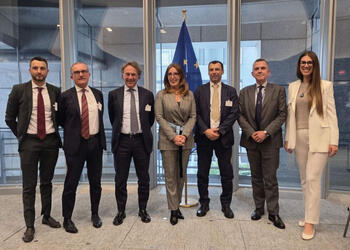
On 15 April in Brussels, Massimo Pavin, President and Chief Executive Officer of Sirmax Group, was a key participant in the event “European Industrial Sovereignty: Crises and Opportunities in Plastic Recycling – The Italian Case”, initiated by Elena Donazzan, Vice-Chair of the European Parliament’s Committee on Industry, Research and Energy (ITRE), and organised by Plastics Recyclers Europe (PRE), the European association representing plastic recyclers, in conjunction with Assorimap, the national association of plastic recyclers and regenerators.
The event provided a critical forum for discussion on the challenges and prospects of the recycling sector, currently navigating a complex phase at the European level amid international competitive pressures, rising costs, and the imperative to strengthen the secondary raw materials market. It formed part of the broader European policy trajectory towards a circular economy, anticipating the Circular Economy Act expected by the end of 2026, which will constitute a strategic milestone to bolster European industrial autonomy, stimulate demand for secondary raw materials, and support the transition towards more sustainable production models. Sirmax’s participation as a speaker underscored the company’s recognised role within the European industrial landscape and the significance of its practical experience within the recycled plastics value chain.
During the roundtable – which also included Paolo Glerean, Chief Officer for EU Relations at Assorimap, member of the Plastics Recyclers Europe Council, and Head of Sales and Marketing at Aliplast; Francesco Pastega, CEO of PreZero Italia; Erica Canaia, President and CEO of Fimic; and Corrado Dentis, President and CEO of Dentis Recycling Italy – Massimo Pavin articulated Sirmax’s perspective as a multinational active in the plastics sector, framing it within a broader reflection on the safeguarding of European manufacturing.
“Europe must rebuild its industrial base,” Massimo Pavin stated. “The goal of restoring it to 20% of the European Union’s GDP by 2035 – a central pillar of the recent Industrial Accelerator Act (IAA) – is crucial. The ongoing global conflicts remind us of the need for a united and more autonomous Europe, the importance of attentive energy and industrial policies, and the imperative to protect our manufacturing. This should not be achieved through protectionist measures, which would trigger retaliatory barriers, but rather through the consistent application of rules to which all must adhere.”
“In this regard,” continued Sirmax’s President, “with respect to the plastics sector, the Circular Economy Act can be an invaluable instrument by mandating the use of a defined proportion of recycled plastic in Made in Europe products, and requiring that this material originates from local recycling streams rather than, for example, Asia. At present, Europe imports substantial volumes from Asia, which undermines our economy and compromises product quality, as plastics not collected, sorted, and recycled within Europe follow different protocols and cannot guarantee verifiable standards. Stricter inbound controls are necessary to ensure fair market conditions capable of safeguarding producers’ competitiveness – or alternatively, to produce in Europe in compliance with European rules.”
“The recycling sector,” Massimo Pavin concluded, “today requires clear, coherent, and enforceable policies that support investment and stimulate demand for recycled materials. Only through structured dialogue between industry and institutions can a truly competitive and sustainable value chain be established.”
Most read news